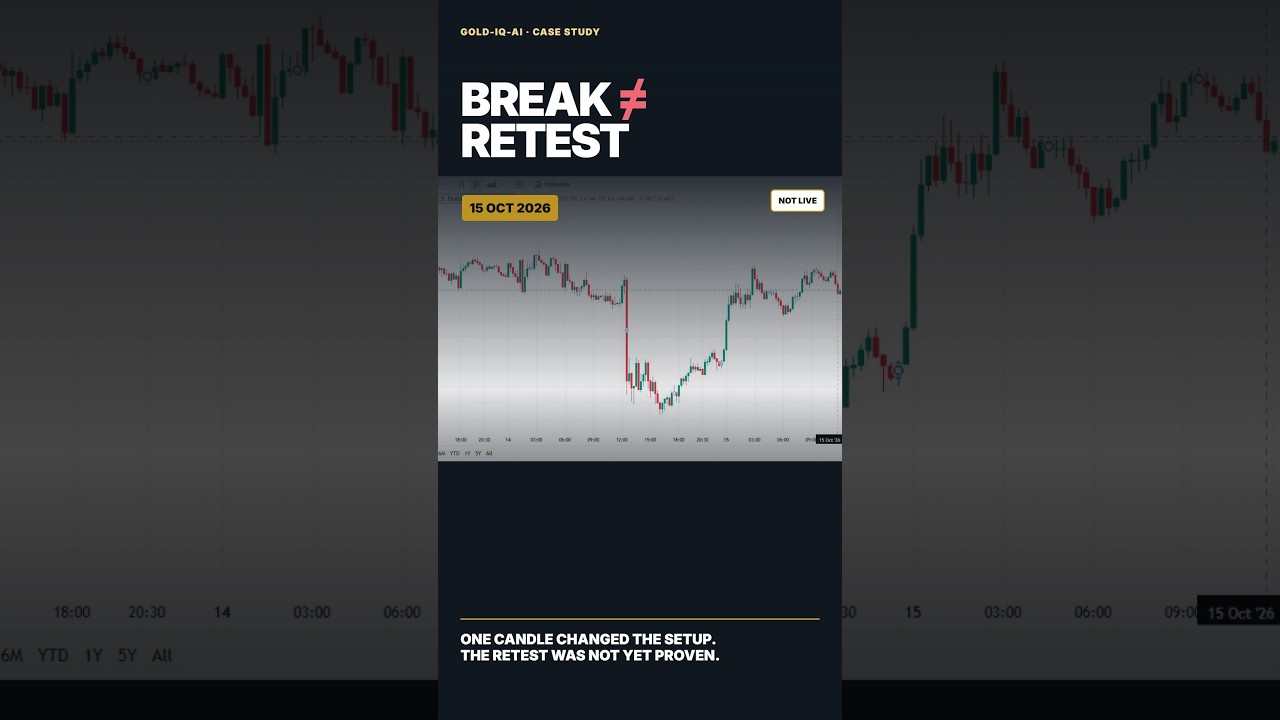
A break above resistance can attract attention, but the next close often tells us more than the first push. The key question is not simply whether Gold crossed a line. It is whether price could remain accepted beyond that line, return to test it, and still close on the correct side.
Today’s 30-second GOLD-IQ-AI video gives a quick visual example of this distinction. The article below turns that chart idea into a repeatable checklist for reading XAUUSD without treating one candle as a guaranteed signal.
Break, retest, and acceptance are three different events
A break occurs when price trades beyond a previously watched area. That is evidence of movement, but not yet proof that the market accepts the new area. A fast wick can cross resistance and reverse before the candle closes.
A retest occurs when price returns to the broken area. The old resistance may begin to act as support, but only if sellers fail to push price decisively back below it. CME Group’s technical-analysis education explains that broken resistance can become support when price returns, while also stressing that support and resistance should be treated as zones rather than exact prices.
Acceptance is the part traders often skip. It is not one magical candle. It is a combination of closes, follow-through, and the market’s response when the level is challenged again. A clean close above the zone strengthens the breakout case; repeated closes back inside the old range weaken it.
What the 15 October close proved
The close shown in today’s video did not prove that Gold must continue higher. No single close can do that. What it did prove was more limited—and more useful: the market had enough demand to finish the observed period on the breakout side of the watched structure rather than immediately surrendering the move.
That changes the next question. Before the close, the question was, “Will price break?” After the close, the question becomes, “Can the broken area hold when it is tested?” This shift prevents traders from chasing the first move and gives them a clearer invalidation condition.
A practical XAUUSD checklist for this week
- Mark a zone, not a single pixel. Use the recent swing high, nearby candle closes, and the width of the consolidation to define an area.
- Separate the intraday spike from the close. A wick beyond resistance shows an attempt; a close beyond it shows stronger acceptance.
- Watch the first return. A controlled retest that holds above the zone is different from a rapid move straight back into the old range.
- Look for follow-through. Higher lows or additional closes above the area support the breakout thesis. Failure to build above it is a warning.
- Define invalidation before entry. If price closes back inside the prior range and cannot recover the level, the breakout thesis needs to be reassessed.
What would weaken the breakout case?
The first warning is a close back below the broken zone. The second is an attempted recovery that fails, turning the same area back into resistance. The third is expanding volatility without directional follow-through: large candles on both sides can indicate uncertainty rather than confirmation.
This is why confirmation should be read in sequence. A break without a stable close is incomplete. A close without a successful retest remains vulnerable. A retest without follow-through can still develop into a failed breakout.
How this connects with GOLD-IQ-AI’s longer guides
For a deeper explanation of acceptance and rejection, read our guide to Gold breakout traps and XAUUSD acceptance. Our failed-breakout case study shows why the return into a prior range matters. For the macro side of Gold, see the practical guide to real yields and Gold.
Bottom line
The 15 October close supplied evidence of acceptance beyond the observed structure; it did not guarantee the next move. The higher-quality decision now comes from the retest: hold above the zone and build follow-through, or fall back into the old range and invalidate the breakout idea.
Educational note: This article explains a chart-reading framework and is not financial or investment advice. Market conditions can change quickly. Recheck the current chart, time frame, liquidity, and economic calendar before making any trading decision.



0 Comments